Run your team without running meetings.
For most of my career, I’ve been building and leading teams across architecture, design, and technology — in-office, hybrid, fully remote, and everything in between.
One pattern has been constant: the need to understand how a team is really doing — without drowning everyone in meetings.
That tension is why I built Team Pulse.
Why Team Pulse exists
Managing teams well is essential.
Managing them through meetings is often inefficient.
As teams scale — or become hybrid or remote — recurring group meetings tend to expand in duration and frequency. Status updates bleed into discussion. Important signals get lost. Quieter voices disappear. And large amounts of time are consumed just synchronising information.
Yet the underlying need is valid:
- What is everyone focused on?
- What’s progressing well?
- Where are the blockers?
- What patterns are emerging across the team?
Team Pulse is built on the idea that these questions don’t require live meetings to answer.
Lessons from my own businesses
In my previous companies, I experimented extensively with lightweight, written check-ins to replace or reduce meetings.
What worked wasn’t the tooling — it was the rhythm.
Regular, predictable check-ins gave me better insight than most meetings ever did. They also created space for people to surface blockers they were uncomfortable raising in more formal or public settings.
The unexpected benefit was transparency.
When team members could see what others were working on — even information that wasn’t strictly necessary for their role — it often led to:
- Faster problem-solving
- Better cross-team empathy
- Fewer duplicated efforts
- Higher overall productivity
In practice, sharing more context — not less — made teams stronger.
Async doesn’t mean disconnected
Team Pulse isn’t about avoiding communication. It’s about choosing the right format.
Written, asynchronous check-ins allow people to respond when they’re focused, not interrupted. They encourage thoughtfulness rather than performance. And they scale far better than meetings as teams grow.
For leaders, this provides a clear, ongoing view of team health and direction.
For teams, it creates shared visibility — a sense of alignment without constant calls.
Everyone benefits from the same source of truth.
How Team Pulse works
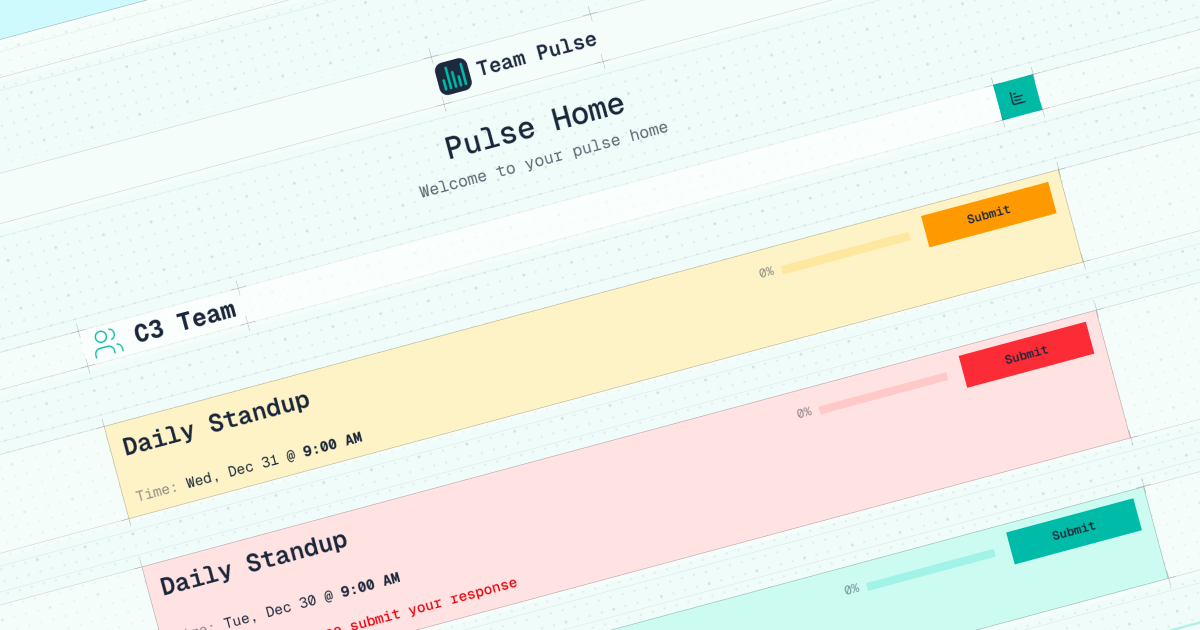
At its core, Team Pulse is built around pulses — recurring check-ins that run at a rhythm that suits your team and business.
- Teams can create one or more pulses
- Each pulse can run daily, weekly, or on a custom cadence
- Questions are short and focused (priorities, progress, blockers, wins)
Each cycle is automatically summarised, highlighting themes, trends, and emerging issues — so you’re not reading dozens of individual updates.
The goal is simple:
clarity without noise.
Designed to stay lightweight
Team Pulse is intentionally opinionated and minimal.
It’s not a task manager.
It’s not a project tracker.
It’s a rhythm and insight tool.
The free version supports small teams getting started. The paid version unlocks richer summaries, more teams, and deeper insights — without adding unnecessary complexity.
More detail is available at: https://teampulse.do
A quiet beginning
Team Pulse has grown out of real usage, real teams, and real operational needs — not a desire to ship “another tool.” Over time, it will evolve carefully, guided by the same principles that led to its creation: clarity, calm, and respect for people’s time.
If you lead a team — or are part of one — and want alignment without constant meetings, Team Pulse may be worth exploring.
Leave a Reply