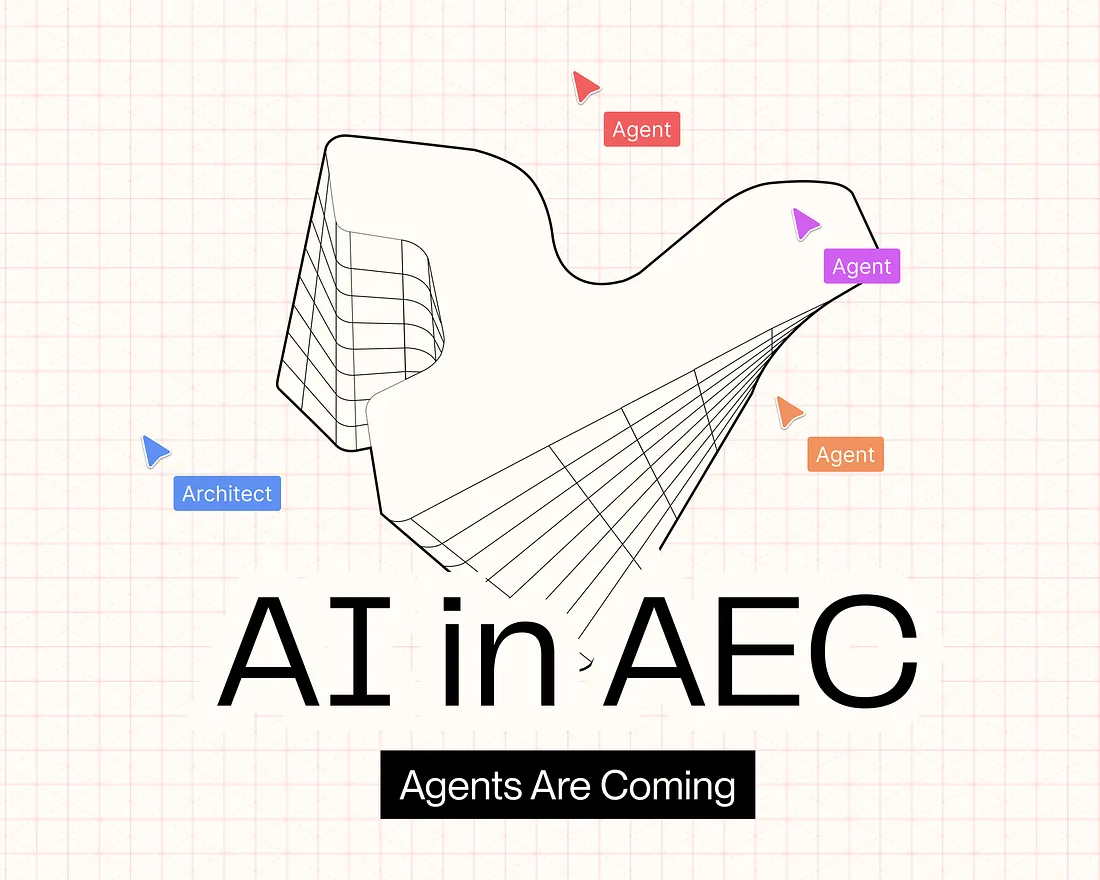
Image courtesy of Paul O’Carrol, Arcol
In an earlier post, I argued that much of the recent excitement around AI in AEC has focused on outputs rather than outcomes. Beautiful images, clever concepts—but very little impact on how firms actually operate day to day.
This post builds on that idea, with a sharper focus on AI agents, why they matter now, and—just as importantly—where they don’t belong.
Two recent articles are particularly useful reference points for this discussion:
- “AI for Architecture Firm Owners” on EntreArchitect
- “AI in AEC: Agents Are Coming” by Paul O’Carroll on Medium
Both are worth reading – or listen to the EntreArchitect podcast – and both point in the same direction: AI’s real leverage in AEC is operational, not creative.
Agents are about systems, not inspiration
Paul O’Carroll’s article makes a clear distinction that’s often missing in AI conversations: agents are not single prompts or tools, but systems that act over time.
They:
- Observe state (projects, data, deadlines)
- Take action based on rules or goals
- Hand off to humans when judgment is required
That framing aligns closely with the EntreArchitect view that AI works best where processes already exist and repeat. As one of the key ideas from that article puts it:
AI is most valuable when it supports defined workflows, not when it tries to invent them.
In other words, agents don’t replace thinking. They reduce friction between moments of thinking.
The real problem: business bottlenecks
Most architectural practices don’t struggle with a lack of creativity. They struggle with flow.
Common bottlenecks include:
- Proposal and variation preparation
- Information handover between phases
- Coordination across tools and disciplines
- QA processes that rely on a few overloaded individuals
- Admin work expanding faster than fees
O’Carroll describes agents as being particularly effective in these in-between spaces—monitoring, nudging, preparing, and escalating—rather than producing final outputs.
This is where agents shine:
- Drafting before review
- Checking before approval
- Summarising before decisions
- Flagging issues before they become problems
Humans stay in control, but they arrive earlier and better informed.
Protecting creative work by automating everything else
Both articles push back—implicitly or explicitly—against the idea that AI should be aimed at design authorship.
That matters.
When AI is applied directly to creative production, firms risk:
- Homogenised outputs
- Shallow iteration
- Less time spent thinking, more time spent reacting
When AI is applied to operational drag, the opposite happens.
By removing:
- Manual coordination
- Repetitive documentation
- Status-chasing and context-switching
You free up time and energy for:
- Design exploration
- Client dialogue
- Critical review
- Leadership and mentoring
AI becomes a buffer around creative work, not an intrusion into it.
Why agents matter now
What both articles recognise—implicitly from different angles—is that firms are under pressure:
- Fees are tighter
- Teams are leaner
- Projects are more complex
- Expectations keep rising
In that environment, incremental efficiency gains matter.
Agent-based AI is compelling not because it’s impressive, but because it:
- Reduces reliance on heroic individuals
- Smooths work through the business
- Makes practices more resilient
This isn’t about futurism. It’s about removing known pain points.
A simple test for adoption
A practical rule of thumb emerges from both pieces:
If a task is repeatable, structured, and slowing your practice down, it’s a candidate for an AI agent.
Conversely, if it’s exploratory, ambiguous, or fundamentally creative, it should remain human-led.
That distinction is critical—and it’s where much of the AI noise in AEC currently goes wrong.
Leave a Reply